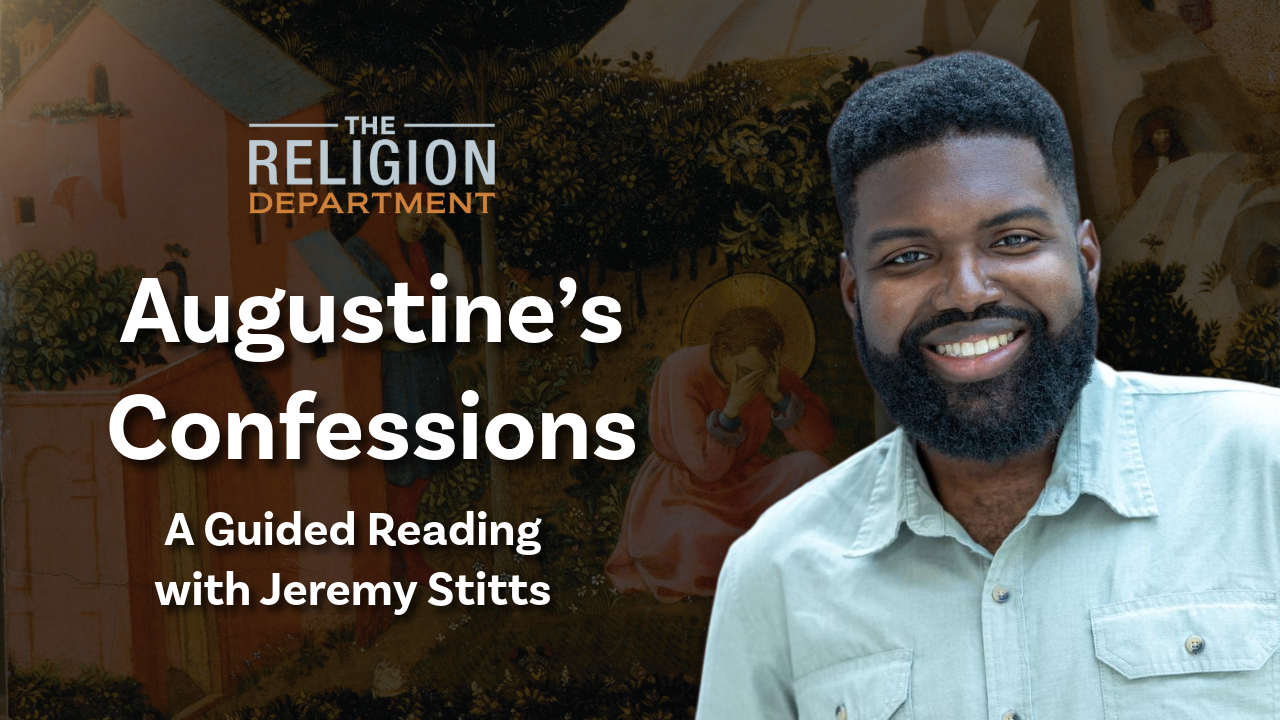
Long before memoir was a genre, Augustine wrote one of history’s most searching accounts of inner life. Confessions is equal parts spiritual autobiography, philosophical experiment, and emotional self-dissection. Princeton’s Jeremy Stitts will guide us through selections that reveal a different side of the Christian saint.
- Dates: Fridays, October 2, 9, 16, 23
- Time: 1:00-2:00pm ET
Augustine’s Confessions is one of the most influential works in Christian history, yet it still feels strikingly alive. It is intimate, raw, searching, dramatic, and often painfully honest in describing the tumultuous life of a future saint. Augustine, one of the famous four Doctors of the Western Church, reflects on ambition, desire, love, grief, guilt, memory, and the exhausting difficulty in striving to become a different person.We’ll follow him through that journey and watch a late Roman intellectual wrestle with some of the most profound questions a person can ask about the self, the soul, and God.
Late Antiquity scholar Jeremy Stitts will guide students through selections from the Confessions with close attention to formative episodes of the saint’s early life, such as the pear theft, Augustine’s career ambition and sensual life, his long relationship with his concubine, his grief over friendship and loss, his complicated bond with his staunchly Christian mother Monica, his renown conversion in the garden, and his later reflections on memory, time, and the nature of creation.
- Featuring:
- ✔ Four 60-minute lectures (recorded live and instantly available)
- ✔ Readings Included
“Before You Read” Guides - ✔ Ongoing Community Discussion
- ✔ Searchable Transcripts
- ✔ Lifetime Access in your Religion Department Library

During this four-week asynchronous reading group, we’ll place the text in the vibrant world of Late Antiquity: a Roman world shaped by elite rhetorical education, the fading prestige of old civic cults, the appeal of movements like Manichaeism and Neoplatonism, both of which shaped Augustine’s intellectual journey, and an increasingly powerful Christian culture that was transforming the social and spiritual life of the empire.
What gives the Confessions its staying power is the way it brings together history, introspection, and literary creativity. Augustine opens up his inner, complicated world with a candor that still feels fresh, posing questions that remain urgent today: Why do we chase things that leave us empty? Why do love and longing so often become tangled with attachment, loss, and disappointment? Why is inner change so hard? How do memory, desire, and faith shape who we become?
This course will delve into the mind of Augustine as a major Christian thinker, a late Roman writer, and, above all, as a deeply compelling guide to the human experience of longing and transformation.

A Guided reading brought to you by Religion for Breakfast
From Andrew Henry's 1M+ subscriber YouTube channel about the academic study of religion, the Religion Department connects world experts to a global learning community. Our classes are designed to accommodate multiple learning styles and schedules.


What drew you to Augustine’s Confessions?
RWhat first drew me to this text was reading it in an undergraduate philosophy class. I was struck by the combination of philosophical depth and emotional vulnerability, and by the way it opens a window onto one man’s interior life in a way we so rarely get from the classical world. Augustine wrestling with his guilt over stealing pears with his friends for no reason, reflecting on his relationship with his concubine, and grappling with the constant pressure from his mother to convert to Christianity made the work feel quite personal and memorable.
I didn’t realize that he went there! What else might people not know about Saint Augustine?
People often imagine Augustine as a famous Christian theologian who said some famous things from a bygone era. They may also know him as a foundational architect of Just War theory. But what surprises many readers is how emotionally exposed and deeply human he is: ambitious, sensual, heartbroken, intellectually restless, and often painfully aware of his own contradictions. Students may also be surprised by the author's literary and psychological perceptiveness.
What will someone get out of this reading group?
Students will gain a richer understanding of one of the most influential works in Christian history and why it has remained so powerful for centuries. They will also gain a clearer sense of the late Roman world in which Augustine lived, with all its educational ideals, religious tensions, philosophical traditions, and changing Christian culture.
Students will gain a richer understanding of one of the most influential works in Christian history and why it has remained so powerful for centuries. They will also gain a clearer sense of the late Roman world in which Augustine lived, with all its educational ideals, religious tensions, philosophical traditions, and changing Christian culture.
Beyond the historical content, students will practice close reading and interpretation of a classic text, both as a historical document and as a deeply crafted literary and theological work. They will also come away with new ways of thinking about desire, identity, and self-examination, all of which make the Confessions feel quite alive even within a secular context.
Do they need any background knowledge?
No prior background is necessary. I’ll provide the historical and religious context needed each week so students can focus on engaging the text closely and thoughtfully.
Course Details

Experience Level
No prior background required

Learning Pace
Comfortable

Interaction
Attend live or participate in the comments
Reading Schedule
Week 1 - Making a Self: Youthful Ambition in a World of Contradiction
Week 2 - The War Within: The Psychological Struggle of "Not Yet"
Week 3 - The Great Turning Point: The Garden Conversion
Week 4 - Memory, Time, and Us: Philosophical Reflections on a Life Lived
Already a Member?
Login Here
Join Our Email List
Stay in the loop about upcoming lectures and department events
Unsubscribe at any time.